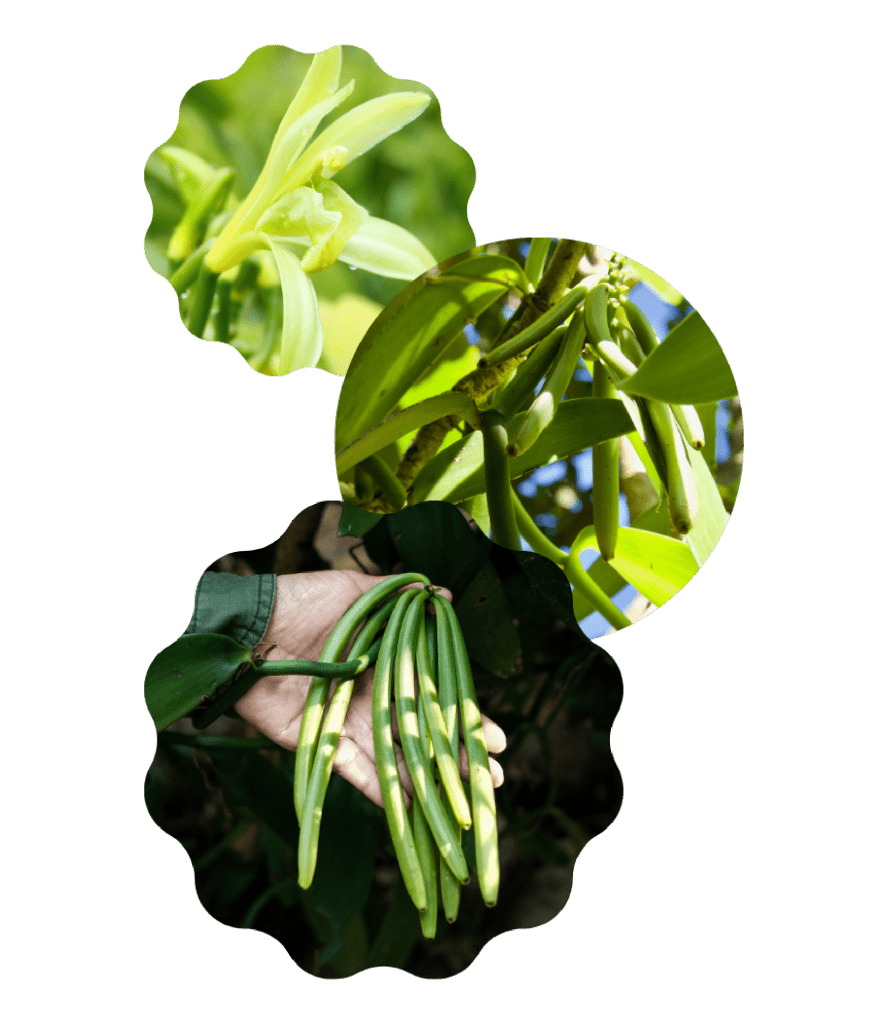
Vanilla: A Symphony of Flavors
and Aroma

The Vanilla aroma is the most used in the world but only 3% of that is coming really from the Vanilla beans.

All the rest (about 97%) is coming from the chemical synthesis of the Vanillin molecule (called simply “Vanillin”, it’s produced from the Phenol or residues of wood pulp containing Lignine) or from a transformation of a natural molecule to Vanillin, (called “Natural Aroma”, it’s typically coming from Ferulic Acid of the rice or from cloves).

There are many well-known products using the Natural Vanilla as a special ingredient, like Coca-Cola Vanilla (in USA), the Nestlé yoghurts and desserts, many excellent Ice Creams, the best patisserie, perfumes like J’Adore (Christian Dior), Obsession (Calvin Klein) and Opium (YSL).
The mother milk seems to have a Vanilla flavor (as for the research of the Monell Chemical Senses Center in Philadelphia) and we are missing it during all our life !

But the fantastic natural Vanilla aroma and flavors are not coming only from Vanillin … in Vanilla has been found more than 150 aromatic compounds, giving that full intense great flavor.

Originally from Mexico, the Aztec were using it (called “Tlilxochill”) to improve the “Xocoatl” drink, made by cacao and honey: the history says that Hernando Cortes, le Conqueror of Mexico, has been invited from the Emperor Montezuma to share some chocolate aromatized with Vanilla.
Since that time, this spice is precious, very rare and highly required worldwide.

The Vanilla sourced from the Indian Ocean (Madagascar, Comoros, Mauritius and Reunion), where is produced 80% of the global crop, is commonly called “Bourbon” variety and it’s considered the best quality with consistent fine organoleptic, delicate floral aroma, creamy, woody, full, mellow, with strong notes of cacao and leather.

The Vanilla beans may be commercialized as Gourmet beans (“Black”) and Extraction grade (“Red”), depending on humidity and content of the active ingredient.
“Shorts” and “Cuts” grades are also available.

Vanilla Sourcing Group - La Vanille
Cultivation de la vanille - Vanilla Sourcing Group

Cultivation

The Vanilla Orchid belongs to the Orchidaceae family. The most commonly cultivated varieties are:

Screenshot_239

Vanilla Planifolia or Fragrans

Grown mainly in the Indian Ocean and considered having the highest quality

Screenshot_239

Vanilla Tahitiensis

Coming from Polinesia and Papua New Guinea, that has usually less Vanillin content and used mainly in parfum industry

Screenshot_239

Vanilla Pompona

Coming from tropical America, less cultivated and used.

In Madagascar there are about 100.000 farmers working on the culture of Vanilla and it takes about 3 years to obtain the first fruits.
The farmers have make the pollination by hand, as the Mexican bees are not working abroad: the flower will stay only 1 day and more than 700 million of flowers are pollinated by hand every year in Madagascar.
It’s necessary to make hand pollination of about 40.000 flowers to obtain just 1 kg of natural ready Vanilla.

The cycle is long:
⦁ September/ October : flowering and fecundation by hand
⦁ June/ September: collect of the pods.
Collecting the Vanilla beans at the right degree of maturity is essential condition to have a good content of Vanillin and other aromatic compounds.

Cultivation de la vanille - Vanilla Sourcing Group

Préparation

The traditional way to prepare the Vanilla (called “curing”) has 3 main phases and all it’s done manually: a thermal treatment on the green fruit, a drying phase to stabilize the product and then an affinage phase.
All done by Planifolia Group experts in our Madagascar unit.

The traditional curing is called also “Bourbon” method and counts till 9 months (2 months for curing and 7 months for refining):

Screenshot_239

⦁ Thermal treatment or Blanching (ECHAUDAGE)

The Vanilla beans are “killed” in hot water, to terminate the ripening process; our Curing Masters know how long for which different type of maturity and type of beans … This will trigger biochemical reactions and let the hydrolyze to transform the -glucosidase endogen in Vanillin and glucose.

Screenshot_239

Steaming

The beans stay in dark cloth or blankets for 24 to 48 hours to sweat

Screenshot_239

Sun drying

The beans are exposed to sun during at least 2 weeks some hours per day and then wrapped in dark cloth to retain heat for the rest of the day: in this way they will start fermentation but also will be stabilized, avoiding development of any mold and microbial contamination. The moisture of the pod should drop down very slowly

Screenshot_239

Triming and refining

During many months the pods are kept in wooden boxes to reduce moisture content again and to develop the aroma and the organoleptic characteristics.

Screenshot_239

Sorting

We inspect, grade and separate by expert hands the beans depending on the dimension and the characteristics (split or not).

Screenshot_239

Conditioning

The beans are prepared in “bundles” or in “vrac” as for the customers’ needs and then we let them resting for at least 3 months in boxes to strengthen the aroma. We inspect it regularly to avoid mildew, any contamination or insect, to guarantee quality and moisture.

From harvesting to shipping, every step of this traditional curing process is closely monitored to ensure a consistent, aromatic vanilla that is ready for our customers.

Cultivation de la vanille - Vanilla Sourcing Group

Ugandan Vanilla: Time to Develop an Alternative Supply Source

Often called the green gold from the pearl of Africa, Ugandan vanilla beans are a wonderful addition to the world’s most beloved flavor. Uganda, while not currently a huge producer of vanilla worldwide, has come to be known for producing high-quality vanilla beans with high vanillin content.

Uganda has two dry seasons making it perfect for growing vanilla that is extremely fresh year-around due to multiple harvests that can take place. We expect Ugandan production from the two annual harvests to increase significantly in the years ahead.

Icône Vanilla Sourcing Group

Uganda has an ideal climate for cultivating high-quality vanilla.

Icône Vanilla Sourcing Group

Vanilla Sourcing Group is collaborating with a local partner to create a traceable, vertical supply chain for its customers in the United States.

Icône Vanilla Sourcing Group

The aim of the program is to establish a sustainable, long-term supply chain between local Ugandan farmers and major trading partners.

Icône Vanilla Sourcing Group

Sustainability and traceability are the cornerstones of the project.
Vanilla Sourcing Group is collaborating with a local partner in Uganda for the implementation of a sustainable and traceable program. Vanilla Sourcing Group acting as the service provider, will contract directly with a farmer network reaching 2,500 vanilla fields. Our 3-year objective is to reach over 5,000 farmers and organically certify over 700 farmers for the program.

Current facilities in Uganda are capable of processing over 20 tons of cured vanilla beans per year. Our partner has worked on and successfully implemented a similar program in Madagascar.

Our Certifications

Quality: Our Commitment to Excellence

Icône Vanilla Sourcing Group

Laboratory

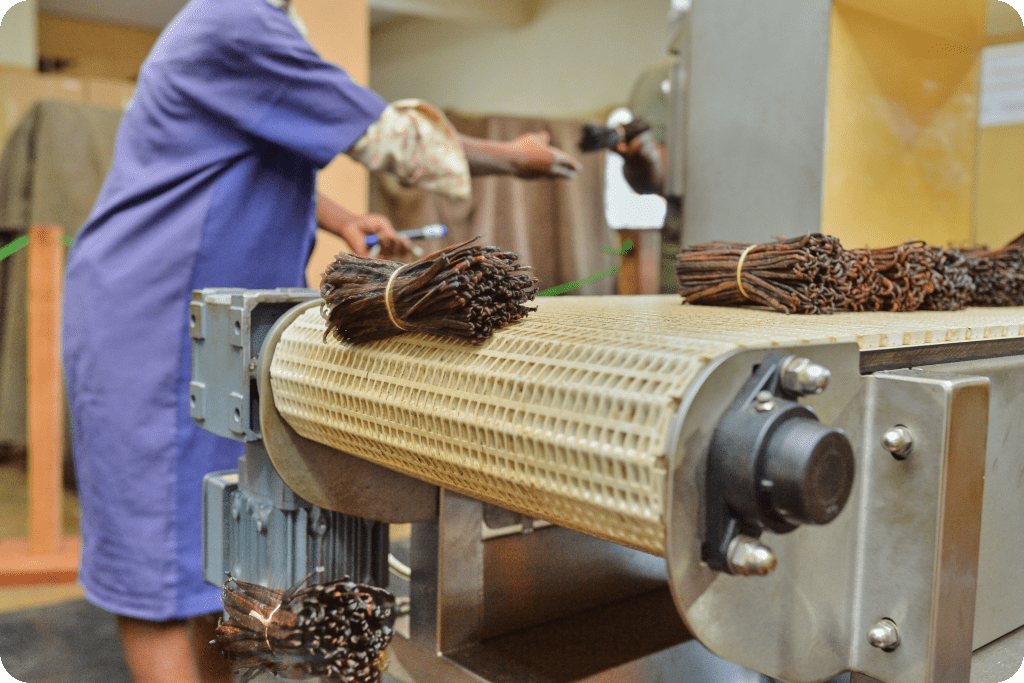
When we choose the green Vanilla or the semi-cured Vanilla to buy, we use strict elements to select the best crops. We check the maturity degree, the length, the variety, the presence of imperfection, of split beans, the absence of insects and molds, the absence of phenolic acid … A scientific approach is necessary and for that we have our own Laboratory to analyze ⦁ moisture of the beans (on wet and on humid) Vanillin content (ISO norm, method UV or HPLC) before any sourcing. If the beans are not reaching our standards, are automatically refused. We want only to buy the best quality beans, use the right curing (thanks to our Curing Masters!) to deliver consistent fine Vanilla.

Icône Vanilla Sourcing Group

Metal Detector

We know how dangerous may be the presence of metallic particles in the beans, that’s why we control each bean twice during the curing procedure (before and after curing), to avoid the presence of any metallic particles.

Icône Vanilla Sourcing Group

HACCP and Certifications

To assure the highest quality and standards, Planifolia Group is using the HACCP standards and norms to analyze and prevent all risks to the final customers Health. Official certifications are important to ensure to our customers that Quality approach is matching the highest standards of the Flavors and Fragrances and of the Food Industry.

Icône Vanilla Sourcing Group

Traceability

It’s really very hard to track all the long trip that the Vanilla beans are doing from the source to the end user. Some farmers are producing few kilograms per year and are at 3-4 walking- traditional boat-4 wheels drive distance to our local units. We are helped buy an external and independent specialist (8 people working for Planifolia Group in that matter) to check each bean when arrives, to track it during all his life and the curing period, till the final delivery, considering the loose of weight and humidity at each stage. We are one of the most advanced suppliers in this matter.